When it comes to supporting your child’s development, you don’t always need expensive therapy equipment.
Many everyday toys and activities available from Kmart can help build important skills such as fine motor development, emotional regulation, social interaction, attention, coordination and early learning. While no toy replaces individualised therapy, the right activities can provide valuable opportunities for learning through play at home.
Our occupational therapists often recommend simple, affordable resources that encourage children to practise skills naturally while having fun.
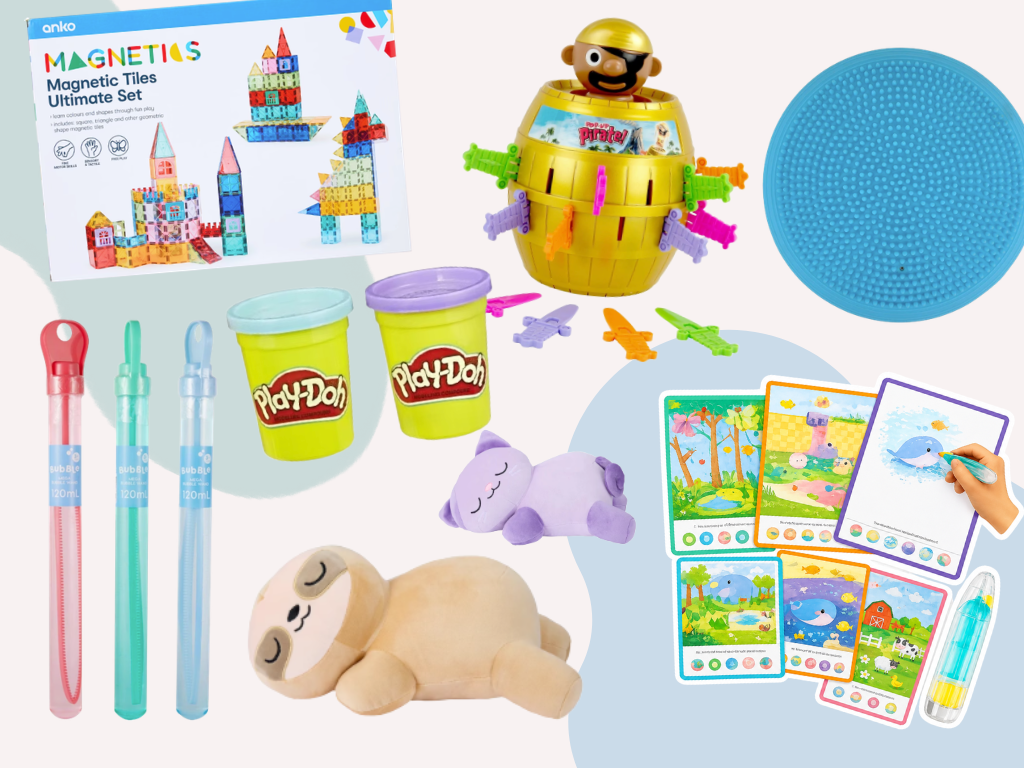
Here are seven OT-approved Kmart finds that support development through everyday play.
1. Bubble Wands
Bubbles are a favourite activity for many children, but they offer far more than entertainment.
Blowing bubbles encourages slow, controlled breathing, which can support emotional regulation and calming. Children can also develop visual tracking skills as they watch bubbles move through the air, while turn-taking opportunities naturally occur when playing with siblings, parents or peers.
Bubbles can also support:
- Attention and focus
- Following simple instructions
- Joint engagement
- Communication and social interaction
- Regulation through breathing and visually stimulating or calming input
Try this at home: Ask your child to pop bubbles with one finger, two fingers, or a specific body part to build listening and body awareness skills.
2. Play-Doh
Play-Doh is one of the most versatile tools for developing fine motor skills.
Rolling, squeezing, pinching and manipulating dough helps strengthen the small muscles in the hands and fingers that are important for everyday tasks such as drawing, cutting, using cutlery, dressing and handwriting.
Play-Doh can help develop:
- Fine motor strength
- Hand coordination
- Pre-writing skills
- Creativity and imagination
- Focus and regulation through deep pressure input
Try this at home: Hide small objects inside the dough and encourage your child to find them using only their fingers.
3. Pop the Pirate
Board games offer valuable opportunities to practise social and emotional skills.
Pop the Pirate is a simple game that helps children learn how to take turns, follow rules, manage anticipation and cope with both winning and losing.
Skills supported include:
- Turn-taking
- Waiting and patience
- Attention and concentration
- Social interaction
- Emotional regulation
- Resilience
- Fine motor control
For some children, managing the surprise element can be challenging, making it a great opportunity to practise flexible thinking and emotional regulation in a safe environment.
4. Magnetic Tiles
Magnetic tiles encourage open-ended construction play while supporting a wide range of developmental skills.
As children build structures, they are constantly planning, problem-solving and experimenting with shapes, balance and design.
Magnetic tiles can support:
- Problem solving
- Spatial awareness
- Fine motor skills
- Bilateral coordination
- Visual memory
- Planning and organisation
Try this at home: Build a simple structure and encourage your child to copy it, gradually increasing the complexity.
5. Water Magic Painting
Water magic painting books are a fantastic mess-free activity that supports early writing skills.
Using the water pen encourages children to practise controlled hand movements while strengthening visual motor integration, the ability to coordinate what the eyes see with how the hands move.
Skills developed include:
- Visual motor integration
- Fine motor control
- Pre-writing skills
- Attention and concentration
- Shoulder stability when used on vertical surfaces
Try this at home: Stick the pages to a wall or easel to encourage shoulder strengthening and improve posture for future handwriting tasks.
6. Weighted Plushies
Weighted plush toys have become increasingly popular for children who benefit from deep pressure sensory input.
The gentle weight can provide proprioceptive input, which helps some children feel more grounded, organised and aware of their bodies. It can be used during mealtimes, quiet times and activities requiring focus.
Potential benefits may include:
- Supporting emotional regulation
- Promoting relaxation
- Increasing body awareness
- Assisting with focus and attention
- Providing comfort during transitions or stressful situations
It’s important to remember that every child responds differently to sensory tools. What works well for one child may not work for another.
7. Wobble Cushions
Wobble cushions can be a useful option for children who find it difficult to sit still during seated activities and seek movement across their day.
The small movements created by the cushion allow children to move while remaining seated, helping some children maintain attention and engagement. The cushion could be placed under their feet or be sat on.
Wobble cushions may support:
- Postural control
- Core strength
- Balance
- Body awareness
- Attention during seated tasks
- Self-regulation
These can be particularly helpful during homework, tabletop activities or mealtimes for children who seek movement.
Why Play Matters
Play is one of the most powerful ways children learn. Through play, children develop the physical, social, emotional and cognitive skills they need for everyday life.
Simple toys and activities often provide the richest opportunities for learning because they allow children to explore, problem-solve, communicate and practise new skills in a fun and meaningful way.
The best toy isn’t necessarily the most expensive one. It’s the one that encourages engagement, interaction and participation.
Looking for More Personalised Support?
Every child develops differently, and not every activity will be the right fit for every child.
If you have concerns about your child’s fine motor skills, attention, regulation, sensory processing or participation in everyday activities, our Occupational Therapy team can help identify strategies tailored to your child’s individual strengths and needs.
At Stronger Together Foundation, our Occupational Therapists work alongside families to support children in building the skills and confidence they need to participate meaningfully at home, preschool, school and within their community.
Need support? Contact our team to learn more about our Occupational Therapy services and how we can help your child thrive through everyday activities and play.