Perhaps your child understands what you’re saying but isn’t using many words. Other people might find their speech difficult to understand, or their educator may have noticed they need extra support communicating at preschool.
It can be hard to know whether to give things more time or ask for advice.
If you’re concerned about your child’s communication, speaking with a speech pathologist is a helpful first step. You don’t need to have all the answers before reaching out. A conversation can help you understand your child’s strengths, explore what you’re noticing and work out whether support would be useful.
Speech therapy is about more than talking
Communication happens in many ways. Children share their interests, feelings and needs through sounds, words, gestures, facial expressions, pictures and communication devices.
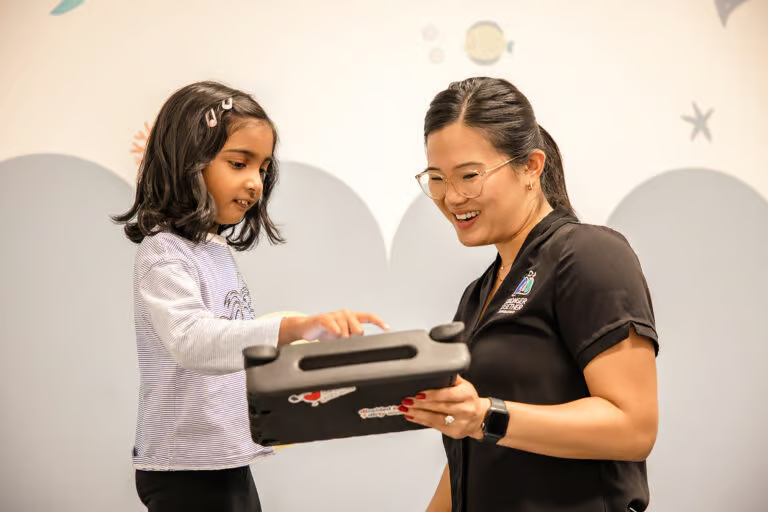
Speech pathologists support children to understand others and express themselves in ways that work for them. This might involve understanding everyday language, asking for help, sharing an idea or joining in a favourite activity.
At Stronger Together Foundation, we work alongside families to understand what matters in their child’s daily life and develop goals together.
“My child understands me but isn’t talking much”
Understanding language and using language are different skills. A child may follow familiar routines and understand everyday words while needing support to express themselves.
Some children who start talking later catch up, while others benefit from ongoing support.
Rather than feeling you need to wait until a concern becomes bigger, you can ask for advice now. Your GP may also recommend a hearing check as part of understanding your child’s communication development.
“Why does my child repeat words from TV?”
Some children repeat words or phrases they have heard from other people, songs or favourite shows. This is known as echolalia.
Repeated language can have meaning for a child, even when the connection is not immediately clear to others. A familiar phrase might be their way of making a request or sharing something with you.
A speech pathologist can help you explore how your child uses these phrases and identify ways to support their communication. Repeating language alone does not tell us whether a child is autistic or needs therapy; it is one part of the broader picture.
What can we do at home?
Everyday moments offer opportunities to connect without turning play or family routines into a lesson.
- Follow your child’s interests, talk about what you’re doing together and enjoy books, songs or familiar games.
- Leave space for your child to respond, whether they use words, a gesture, a sound or another form of communication.
- Acknowledge their communication attempts by repeating the phrase or sound back to them or simply saying ‘yeah’
- You can also make comments instead of asking lots of questions. During car play, for example, “The car is going up!” gives your child language connected to something they are already enjoying.
If your child loses words or communication skills they previously used, speak with your GP promptly.
When might my child benefit from support?
It may be helpful to seek advice if your child:
- Uses fewer words or word combinations than expected for their age.
- Finds it difficult to understand questions or everyday instructions.
- Has speech that is difficult for others to understand.
- Becomes frustrated when they cannot get their message across.
- Finds it difficult to share their thoughts, needs or experiences.
- Stutters, or seems uncomfortable or worried about speaking.
These observations are a starting point for a conversation, rather than a checklist for diagnosing a difficulty. A speech pathologist will consider your child’s age, communication across different settings and, where relevant, the languages they use.
How can Stronger Together Foundation help?
Our speech pathologists provide individualised, neurodiversity-affirming support, shaped around your child’s strengths, interests and your family’s priorities.
Support is available at our Castle Hill clinic, at home, in early childhood education settings, at school and in the community. We work with the important people in your child’s life so strategies can become part of everyday routines. Learn more about our speech therapy services.
For children aged 2–5 years who have not yet started school, our free communication screeners can be a useful starting point. These individual, 30-minute appointments explore communication skills and help identify whether a more detailed assessment may be recommended. A screener does not provide a diagnosis. Find out about our free communication screeners.
Wondering whether speech therapy could help your child? Call our team on 1300 111 783 or enquire through our speech therapy page. We’re here to listen and help you explore the next step.